Friday, 27 January 2012

Dunrobin Castle Gardens

Dunrobin Castle
I had never been to Dunrobin Castle before my trip home to Scotland last year, but since it's a pleasant driving distance from my brother's house, on a picturesque route, I put that to rights.  It is a magnificent property, looking very much like a Fairytale Castle or French Chateau.   The gardens are magnificent, and the views from the Castle, across formal beds and topiary, and out to the sea, are quite beautiful.  When I was a kid, I always misheard the name, and thought it was "Done Roamin' Castle", and if I had the where-with-all to own this little pile, I would certainly be done roaming for good.  I would become a hermit and never leave the place....although on second thoughts, if I had the kind of fortune required to own this place, I would surely need the odd trip to Monaco, or Capri, or Biarritz, just to make sure I didn't start to take things for granted at home!


The elevation of the house above the gardens allows for great views of the formal beds


You half expect Rapunzel to let her hair down from these turrets


The damp weather in these sheltered, northerly climes clearly suits Gunnera - the leaves are immense!


A charming path down to the beach

The potager is highly productive and decorative.  Love the terracotta forcing pots for the rhubarb.


Potted trees are a feature of the gardens

Another feature are these rose pyramids.  We had missed their bloom peak, but these structures still made a good impact 

Low profile apple and pear espaliers formed low hedges.  Their bark was fuzzy with lichen.


Every crack in the ancient stone staircase was bursting with self-sown plants - all looking perfectly happy in their cramped quarters.

What perfectly crisp hedge lines!

Tuesday, 24 January 2012

A little piece of the mediterranean.....but where?

Where do you think this is? Amalfi Coast? Santorini? Malaga? Provence?


Ok, surely Provence.....makes me think of the Luberon

But look at that massive rosemary....now that makes me think it must be the Aegean.  And I think you only get a sky like that in Greece

Figs - Greece for sure
Hmmm, now artichokes definitely make me lean more toward Italy or France


Grapevines
Hang on.....that looks more like Denmark...or Holland....

Quite clearly Northern Europe
Ok, I'm sure you are tired of the guessing game by now.  All is revealed:

http://www.scotlands-enchanting-kingdom.com/st-andrews-scotland.html


Located just across the Firth of Forth from Edinburgh, on a chunk of land that looks like the profile of a scottie dog, in the Kingdom of Fife, Culross is a quaint village to visit.  The main attraction is the charming "Culross Palace", a National Trust for Scotland property, not so much a Palace as a gem of 16th century luxury.  The day we visited last July was picture-postcard perfect, and the steeply terraced garden of the Palace was baking in the sun, sheltered from cold sea breezes, and radiating heat from the ancient stone walls all through the garden.  As you can see from the photos, on a warm day, it feels very much like it would belong on the Mediterranean coast.  The garden is jam packed with huge rosemary, lavender and sage bushes, artichokes, bay laurels, figs, roses, centranthus, poppies, santolina and boxwoods.  The paths are cleverly lined with small clam shells instead of pea gravel, and the chickens were not at all camera shy! Hmmm.....I can smell the herby fragrance! Lovely!  Enjoy!


Saturday, 21 January 2012

Provost Skene's House, Aberdeen

A very elegant 18th century dining room.  Wooden panelling keeps out Scottish draughts and adds grandeur.


Sometimes, as they say, the best things in life are free, and this was certainly true during my visit to Scotland last summer, where I was delighted to find that many museums and galleries are still free of charge (although everyone who visits should still do what they can in the form of donation).   Provost Skene's House is a museum run by Aberdeen Art Galleries and Museums, which is an absolute delight to visit.  First mentioned in records in 1545, the house was an important dwelling of the new Town through the 16th to 18th centuries, and it was reputedly commandeered by the Duke of Cumberland as he travelled north to the slaughter at the Battle of Culloden, where he earned the nickname "Butcher Cumberland".  Indeed, the house was known as "Cumberland House" for the next 200 years as a result, during which time it eventually became a public rooming house.  The immediate vicinity of the house gradually devolved into a slum, which was eventually cleared out in improvements between the wars. Remarkably, Provost Skene's House was spared destruction, although it was ultimately surrounded by a sea of 1960s/70s concrete, which remains to this day.  Recently, the council has agreed that their vacant office building, the most prominent eyesore in the area, should be demolished and the site sold.  Hopefully the planners will get the next phase right.  Nonetheless, Provost Skene's House has managed to survive thus far, and will surely withstand any future insults!   And who was Provost Skene anyway?  Well, he was not the original occupant of the house, which was built at least a century before he lived there in the latter part of the 16th century.  He was the Provost of Aberdeen from 1676 to 1685, the Provost being the head of the town council, similar to a Mayor.
In any case, the interior of the house forms a wonderful series of rooms displaying period furnishing from the 17th to early 19th centuries, and an absolutely remarkable painted ceiling in what was originally a catholic chapel.  The painted ceiling naively represents the life of Jesus and was hidden for  three centuries, only to be rediscovered when the rooming house was being restored.  When we visited, we were lucky enough to be in the room with a native Aberdonian guide who really knew all of the history and allegory in the painting and who gave a very colourful account of the scenes depicted.  Definitely worth the entry price and a real gem of the city.


A richly carved "press", possibly from the low countries, with whom the port of Aberdeen had strong trading relationships

A very toasty spot!

love the long case clock

The painted chapel ceiling, thought to have been painted by itinerant Italian artists

Much of the ceiling is in near perfect condition, after being concealed for nearly 300 years


There are 10 panels in all, each telling an important part of the life of Jesus - and most with some characters that definitely look more like locals than folk from the Holy Land!

Love the crewel work drapery


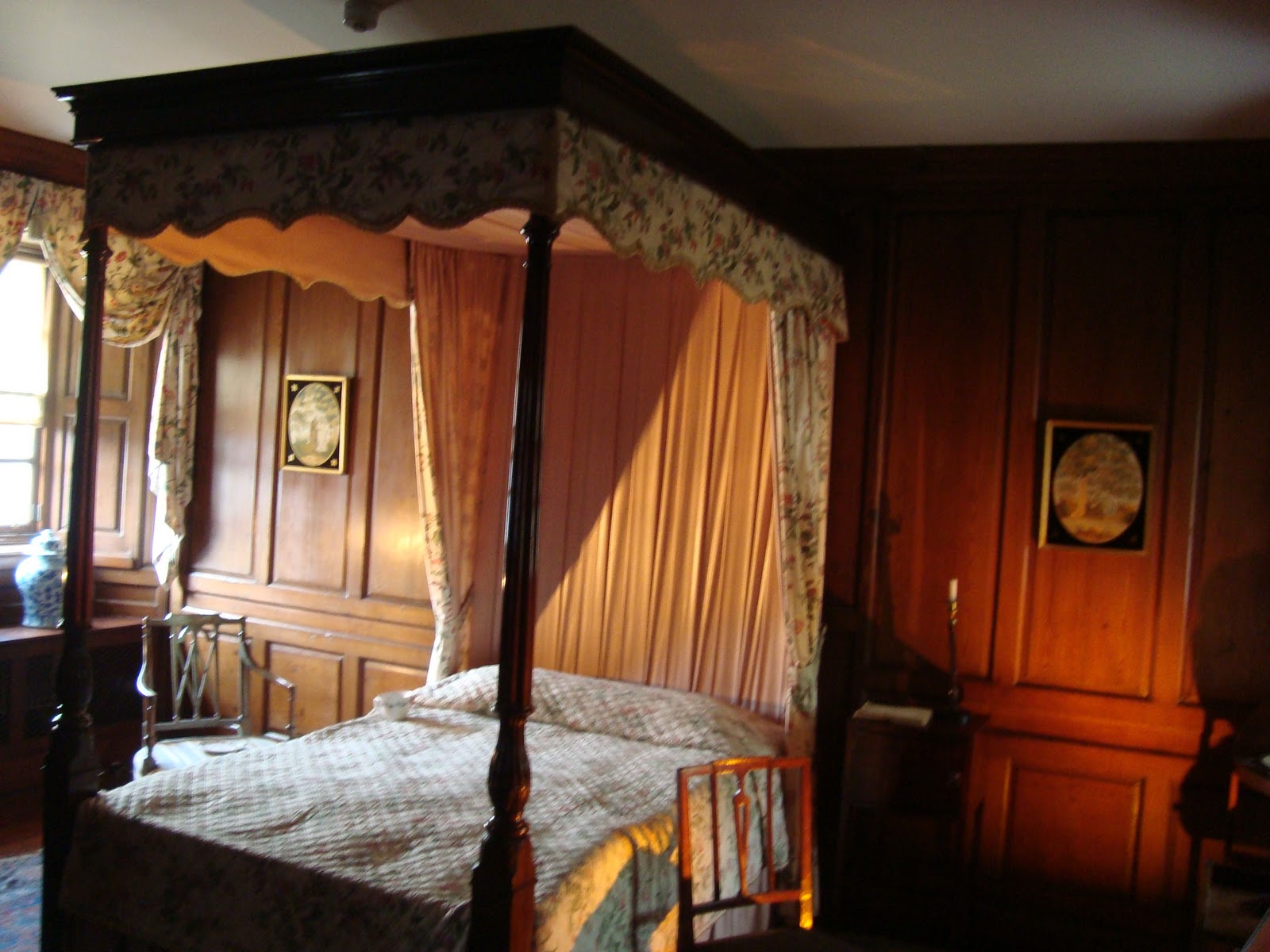
A perfectly charming bedroom


A regency period sitting room.  That yellow silk was extremely intense, but in the grey gloom of an Aberdeen winter, would be reminiscent of warm sunshine, and it worked well in the room

A perfect place to take tea.